
Promoting Meaningful Patient Engagement in Paediatric Rare Disease Research
TEDDY Network participated in the World Orphan Drug Congress Europe 2026, held on 26 – 28 October at the RAI Congress Centre in Amsterdam, the Netherlands. The event brought together stakeholders from across the rare disease community, including researchers, industry representatives, policymakers and patient organisations, to discuss developments across the orphan drug and rare disease landscape.
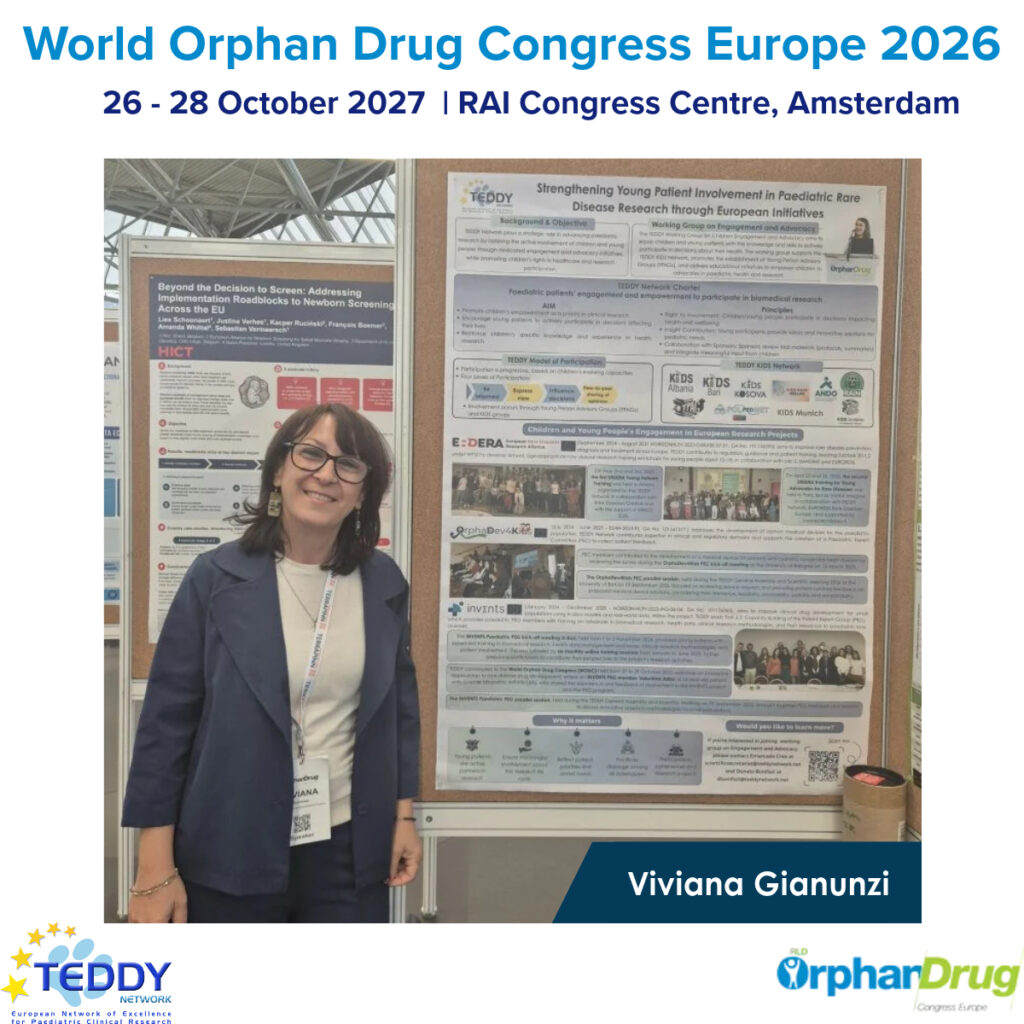
TEDDY Network was represented by Viviana Gianunzi, Fondazione per la Ricerca Farmacologica Gianni Benzi (FGB), a member of TEDDY Network, who presented the poster entitled “Strengthening Young Patient Involvement in Paediatric Rare Disease Research through European Initiatives.”
The poster highlighted TEDDY Network’s strategic role in promoting the meaningful involvement of children, adolescents and young people in paediatric rare disease research through the activities of its Working Group on Children Engagement and Advocacy and the TEDDY KIDS Network. It presented the structured engagement model developed within TEDDY Network and formalised in the TEDDY Charter, illustrating how young patients can participate as active partners throughout research and innovation processes.
The poster showcased three European initiatives demonstrating the application of this approach. Within ERDERA, TEDDY Network coordinates the first edition of the ERDERA -Young Patients Training (Athens 2025) and second edition of the ERDERA Training for Young Advocates for Rare Disease (Paris 2026), which equips children and adolescents with knowledge and skills to participate actively in biomedical research, particularly in paediatric rare diseases.
Through INVENTS, the paediatric Patients Expert Group (PEG) provides a structured training pathway to strengthen young patients’ understanding of biomedical research, clinical studies and healthcare innovation.
In parallel, the Patient Experts Committee (PEC), established within OrphaDev4Kids, contributes to identifying unmet needs, reviewing study materials and co-designing orphan medical devices, helping ensure that the perspectives of children and adolescents are considered throughout the research and development process.
Together, these initiatives demonstrate the value of structured training and engagement in empowering young patients as active partners in paediatric rare disease research and innovation, ensuring that their perspectives inform scientific processes and the development of new therapies and technologies.